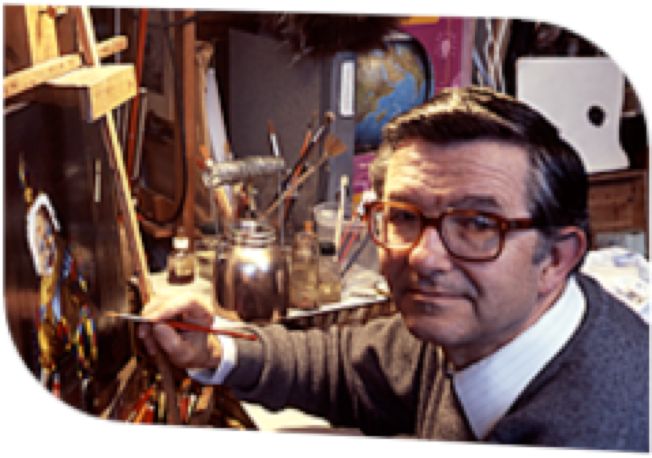
Richard Gautier
Going against the grain of contemporary trends, the work of Richard Gautier asserts an almost militant fidelity to reality—or, more precisely, to a masterfully crafted illusion of it.
A trajectory defined by both academic rigor and a spirit of defiance
Trained at the Academy of Fine Arts in Poitiers and subsequently at the Académie Anquetin in Neuilly, the painter developed a pictorial language early on that is rooted in precision, yet also characterized by a resistance to dogma. While academic training advocates for the imitation of a model, Gautier chose to understand its underlying mechanisms in order to better transcend them.
This dual path—combining formal fine arts education with private study under Louvre copyists, such as Mme Versini—forged an independent artistic vision. Gautier does not merely copy; he analyzes, deconstructs, and then reconstructs the visible world.
His early entry into the circle of realist painters, under the sponsorship of Henri Cadiou, marked a decisive turning point. As early as 1966, with his work *Le torchon* (The Dishcloth), he demonstrated a remarkably high level of technical mastery, while laying the foundations for an oeuvre centered on illusion and perception.
*Trompe-l’œil* as a language, not merely a technical feat
For Richard Gautier, *trompe-l’œil* is never a simple exercise in virtuosity; it functions as a language in its own right. The artist’s goal is not merely to deceive the eye, but to awaken the mind.
His compositions—featuring suspended objects, crumpled paper, or candies frozen in an ambiguous temporality—play with the boundary between presence and absence. The viewer’s gaze hesitates, wavers, and draws closer. The work demands a pause—a suspension of reality.
A body of work imbued with symbolism
Beyond mere technique, Richard Gautier’s work is distinguished by its symbolic density. Every element is conceived as a sign. Nothing is left to chance.
His latest book, *Le Pinceau philosophe* (The Philosopher’s Brush), sheds light on this dimension: each painting corresponds to a reading—or an interpretation, sometimes even multiple ones. In it, the artist reveals an ambition rare within the genre of *trompe-l’œil*: to go beyond mere imitation and achieve a form of visual storytelling.
An object becomes a metaphor. A composition becomes an allegory. The viewer is invited to read just as much as to look.
Against the Grain of Contemporary Trends
In an art world often dominated by concepts, speed, and dematerialization, Richard Gautier champions the value of taking one’s time, alongside rigor and mastery.
He acknowledges it himself: *trompe-l’œil* is no longer in vogue—it is too demanding, too slow, and too rigorous. Yet, it is precisely this level of demand that constitutes his strength today.
By passing on the techniques of the Dutch masters—glazing, layering, and the nuanced handling of light—for over fifty years, he preserves a tradition of knowledge that is now under threat. His studio thus becomes a space of both resistance and transmission.
Between Illusion and Truth: A Work in Equilibrium
The painter’s power lies in this constant tension: to reveal without fully unveiling, to deceive without lying. His works pose a fundamental question: what is it that we are actually seeing? Is an image a surface or a depth? Is it something self-evident, or an enigma?
At a time when images are ubiquitous, instantaneous, and often ephemeral, the painter offers the opposite: an image that is slow, constructed, and almost meditative—an image that resists.
Richard Gautier is more than just an exhibitor; he is a conduit of tradition. In an artistic landscape in constant flux, he reminds us of a truth too often forgotten: modernity does not always lie in rupture—sometimes, it resides in fidelity.
Text taken from the review by © Canoline Critiks